庑 (wǔ) means "veranda; corridor" in Chinese. It has 7 strokes with the radical 广.
Rated 3.5/5 in difficulty (challenging).
Appears in 3+ common words including 廊庑 (láng wǔ), 堂庑 (táng wǔ), 庑殿 (wǔ diàn).
Due to its 7 strokes, Hanzi Writer's error detection shows 庑 requires focused practice — most learners need 10+ attempts for consistent accuracy.
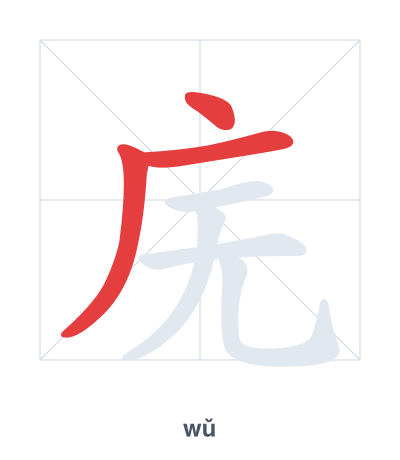
Open Hanzi Writer to see the animated stroke order and practice writing 庑 with real-time feedback.
The character 庑 (wǔ) is written with 7 strokes. Follow the standard Chinese stroke order: top to bottom, left to right, outside before inside. The radical 广 is one of its key components.
Practice the correct stroke order with the Hanzi Writer app to see animated stroke-by-stroke guidance with real-time feedback.
庑 means veranda; corridor.
庑 is a compound character with the radical 广 (roof/shelter) indicating a building, and 无 (wú, 'without') serving as a phonetic component. It originally referred to a covered walkway or veranda, a structure with a roof but open sides.
💡 Memory Tip: Picture a building (广) with no walls (无), just a roof over an open veranda where you can walk.
廊庑下可以避雨。
láng wǔ xià kě yǐ bì yǔ
One can take shelter from the rain under the corridor.
堂庑非常宽敞。
táng wǔ fēi cháng kuān chǎng
The hall and corridors are very spacious.
这是一个庑殿顶。
zhè shì yí gè wǔ diàn dǐng
This is a hip roof (traditional Chinese architecture).
Open Hanzi Writer to see the animated stroke order and practice writing 庑 with real-time feedback.
✨ Animated stroke order · Handwriting recognition · HSK-graded practice · Free to use
The character 庑 combines the radical 广 (building or roof) with 无 (wú), which provides the sound. The radical 广 indicates that 庑 relates to architecture, and the full character means a veranda or corridor, which is a roofed building extension. So the meaning comes from the radical, while 无 is purely phonetic.