杞 (qǐ) means "wolfberry; surname Qi" in Chinese. It has 7 strokes with the radical 木.
Rated 3.5/5 in difficulty (challenging).
Appears in 3+ common words including 枸杞 (gǒu qǐ), 杞人忧天 (qǐ rén yōu tiān), 杞子 (qǐ zi).
Due to its 7 strokes, Hanzi Writer's error detection shows 杞 requires focused practice — most learners need 10+ attempts for consistent accuracy.
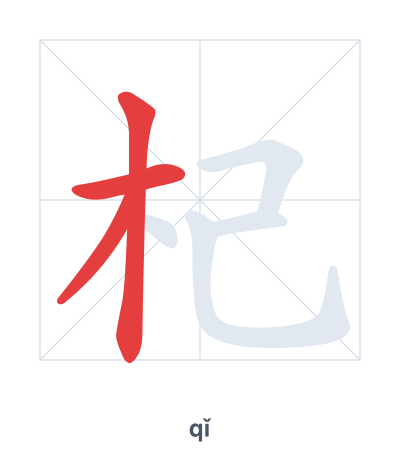
Open Hanzi Writer to see the animated stroke order and practice writing 杞 with real-time feedback.
The character 杞 (qǐ) is written with 7 strokes. Follow the standard Chinese stroke order: top to bottom, left to right, outside before inside. The radical 木 is one of its key components.
Practice the correct stroke order with the Hanzi Writer app to see animated stroke-by-stroke guidance with real-time feedback.
杞 means wolfberry; surname Qi.
杞 is a compound character with the radical 木 (tree) and the phonetic component 己 (jǐ). It originally referred to the wolfberry tree, known for its small red berries.
💡 Memory Tip: Picture a wolfberry tree (木) with a coiled snake (己) wrapped around it, guarding the bright red berries.
喝枸杞水有好处。
hē gǒu qǐ shuǐ yǒu hǎo chù
Drinking goji berry water is beneficial.
你不要杞人忧天。
nǐ bú yào qǐ rén yōu tiān
Don't worry unnecessarily.
汤里放了一些杞子。
tāng lǐ fàng le yī xiē qǐ zi
Some goji berries were put in the soup.
Open Hanzi Writer to see the animated stroke order and practice writing 杞 with real-time feedback.
✨ Animated stroke order · Handwriting recognition · HSK-graded practice · Free to use
The character 杞 combines the radical 木 (wood/tree) on the left with 己 (self) on the right. The tree radical indicates that 杞 is related to a plant, specifically the wolfberry shrub. The right side 己 serves as a phonetic component, hinting at the pronunciation qǐ.