杩 (mà) means "bedstead; support frame" in Chinese. It has 7 strokes with the radical 木.
Rated 3.5/5 in difficulty (challenging).
Appears in 3+ common words including 杩杈 (mà chā), 杩头 (mà tóu), 杩子 (mà zi).
Due to its 7 strokes, Hanzi Writer's error detection shows 杩 requires focused practice — most learners need 10+ attempts for consistent accuracy.
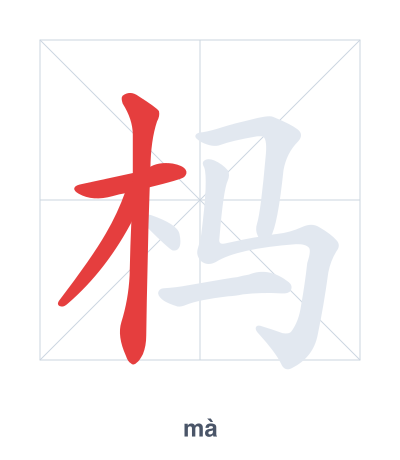
Open Hanzi Writer to see the animated stroke order and practice writing 杩 with real-time feedback.
The character 杩 (mà) is written with 7 strokes. Follow the standard Chinese stroke order: top to bottom, left to right, outside before inside. The radical 木 is one of its key components.
Practice the correct stroke order with the Hanzi Writer app to see animated stroke-by-stroke guidance with real-time feedback.
杩 means bedstead; support frame.
杩 is a phono-semantic compound character. The radical 木 (wood/tree) indicates it relates to wooden objects, while 马 (horse, pronounced mǎ) provides a phonetic clue (the character is mà). Together, they suggest a wooden structure for support, like a bedstead or a frame for carrying things.
💡 Memory Tip: Imagine a wooden (木) horse (马) that forms the support frame for a bed, so you can sleep on a horse-shaped bedstead.
这是一个木杩杈。
zhè shì yí gè mù mà chā
This is a wooden pitchfork.
这个杩头很结实。
zhè ge mà tóu hěn jiē shí
This wooden support is very sturdy.
他在修理杩子。
tā zài xiū lǐ mà zi
He is repairing the wooden frame.
Open Hanzi Writer to see the animated stroke order and practice writing 杩 with real-time feedback.
✨ Animated stroke order · Handwriting recognition · HSK-graded practice · Free to use
The left part is 木, meaning wood, which shows that the character relates to wooden objects. The right part is 马, which provides the pronunciation mà. Together, they suggest a wooden frame or support, such as a bedstead.