苁 (cōng) means "Cistanche (a type of herb)" in Chinese. It has 7 strokes with the radical 艹.
Rated 3.5/5 in difficulty (challenging).
Appears in 3+ common words including 苁蓉 (cōng róng), 肉苁蓉 (ròu cōng róng), 苁蓉片 (cōng róng piàn).
Due to its 7 strokes, Hanzi Writer's error detection shows 苁 requires focused practice — most learners need 10+ attempts for consistent accuracy.
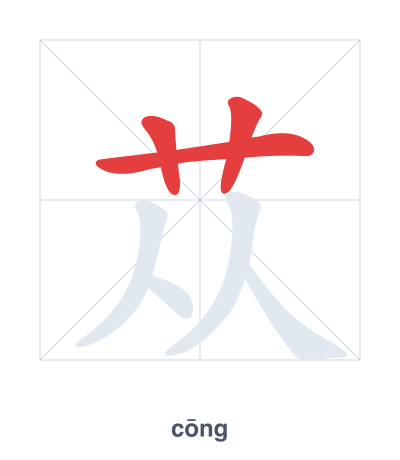
Open Hanzi Writer to see the animated stroke order and practice writing 苁 with real-time feedback.
The character 苁 (cōng) is written with 7 strokes. Follow the standard Chinese stroke order: top to bottom, left to right, outside before inside. The radical 艹 is one of its key components.
Practice the correct stroke order with the Hanzi Writer app to see animated stroke-by-stroke guidance with real-time feedback.
苁 means Cistanche (a type of herb).
苁 is a phono-semantic compound: the radical 艹 (grass) indicates it is a plant, while the component 从 (cóng) provides the pronunciation. Cistanche is a desert herb that commonly grows attached to the roots of other plants, aligning with the idea of 'following' (从).
💡 Memory Tip: Imagine a grass plant (艹) that follows (从) the roots of another plant, sneaking along like a thirsty herbal spy in the desert.
苁蓉是中药。
cōng róng shì zhōng yào
Cistanche is a traditional Chinese medicine.
肉苁蓉很名贵。
ròu cōng róng hěn míng guì
Cistanche is very precious.
他在喝苁蓉片。
tā zài hē cōng róng piàn
He is drinking cistanche tea.
Open Hanzi Writer to see the animated stroke order and practice writing 苁 with real-time feedback.
✨ Animated stroke order · Handwriting recognition · HSK-graded practice · Free to use
苁 has the grass radical 艹 on top, indicating it is a plant. The bottom part 从 (cóng) provides the sound and also suggests something that grows together, like a cluster. This structure helps you remember it is a type of herb.