杓 (biāo) means "ladle" in Chinese. It has 7 strokes with the radical 木.
Rated 3.5/5 in difficulty (challenging).
Appears in 3+ common words including 杓子 (biāo zi), 水杓 (shuǐ biāo), 木杓 (mù biāo).
Due to its 7 strokes, Hanzi Writer's error detection shows 杓 requires focused practice — most learners need 10+ attempts for consistent accuracy.
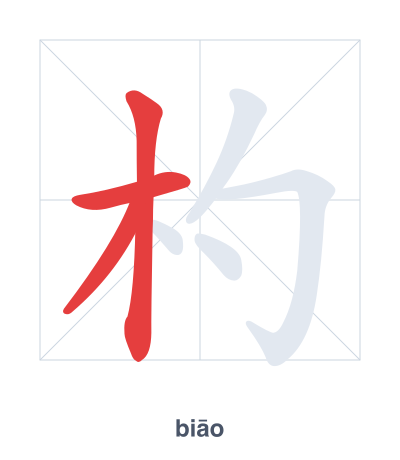
Open Hanzi Writer to see the animated stroke order and practice writing 杓 with real-time feedback.
The character 杓 (biāo) is written with 7 strokes. Follow the standard Chinese stroke order: top to bottom, left to right, outside before inside. The radical 木 is one of its key components.
Practice the correct stroke order with the Hanzi Writer app to see animated stroke-by-stroke guidance with real-time feedback.
杓 means ladle.
The character 杓 combines the radical 木 (wood) on the left with 勺 (spoon, a pictograph of a ladle with a handle) on the right, indicating a ladle made of wood. In ancient forms, 勺 depicted a spoon-shaped vessel, and adding 木 specifies the material or the tool itself.
💡 Memory Tip: Picture a wooden tree (木) next to a giant spoon (勺) scooping soup—that's a ladle!
请给我一个大杓子。
qǐng gěi wǒ yí gè dà biāo zi
Please give me a large ladle.
他用水杓盛水。
tā yòng shuǐ biāo shèng shuǐ
He used a water ladle to scoop water.
厨房里有一个木杓。
chú fáng lǐ yǒu yí gè mù biāo
There is a wooden ladle in the kitchen.
Open Hanzi Writer to see the animated stroke order and practice writing 杓 with real-time feedback.
✨ Animated stroke order · Handwriting recognition · HSK-graded practice · Free to use
杓 is made of two parts: the left side 木 (wood) and the right side 勺 (spoon). The wood radical shows it is made from wood, while 勺 gives the shape of a scooping tool. Together they form a wooden ladle.