苄 (biàn) means "Benzyl (chemical term)" in Chinese. It has 7 strokes with the radical 艹.
Rated 3.5/5 in difficulty (challenging).
Appears in 3+ common words including 苄基 (biàn jī), 苄胺 (biàn àn), 氯化苄 (lǜ huà biàn).
Due to its 7 strokes, Hanzi Writer's error detection shows 苄 requires focused practice — most learners need 10+ attempts for consistent accuracy.
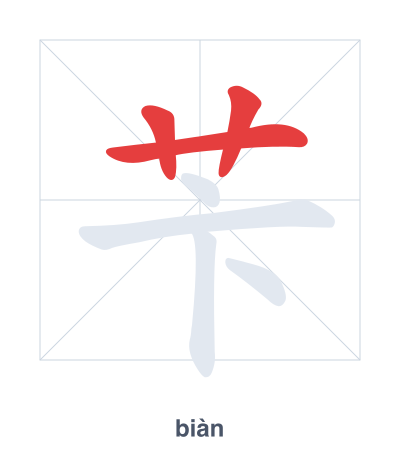
Open Hanzi Writer to see the animated stroke order and practice writing 苄 with real-time feedback.
The character 苄 (biàn) is written with 7 strokes. Follow the standard Chinese stroke order: top to bottom, left to right, outside before inside. The radical 艹 is one of its key components.
Practice the correct stroke order with the Hanzi Writer app to see animated stroke-by-stroke guidance with real-time feedback.
苄 means Benzyl (chemical term).
苄 is a compound character with the radical 艹 (grass/plant) indicating its botanical origin, and 卞 (biàn) serving as a phonetic component. The character was created in modern chemistry to represent the benzyl group, which derives its name from benzoin, a plant resin. Structurally, the grass radical hints at the plant source, while the phonetic 卞 provides the pronunciation biàn.
💡 Memory Tip: Picture a grass plant (艹) with a little 'benzyl' tag hanging down (卞 like a hook), reminding you it's a chemical from plants.
这是一个苄基。
zhè shì yí gè biàn jī
This is a benzyl group.
苄胺是透明的。
biàn àn shì tòu míng de
Benzylamine is transparent.
氯化苄有气味。
lǜ huà biàn yǒu qì wèi
Benzyl chloride has an odor.
Open Hanzi Writer to see the animated stroke order and practice writing 苄 with real-time feedback.
✨ Animated stroke order · Handwriting recognition · HSK-graded practice · Free to use
苄 is a phono-semantic compound. The top radical 艹 (grass) hints that this character is related to organic chemicals, often derived from plants. The bottom part 卞 (biàn) provides the pronunciation, though it originally means 'lower'.