杌 (wù) means "Stool; stump" in Chinese. It has 7 strokes with the radical 木.
Rated 3.5/5 in difficulty (challenging).
Appears in 3+ common words including 杌子 (wù zi), 木杌 (mù wù), 矮杌 (ǎi wù).
Due to its 7 strokes, Hanzi Writer's error detection shows 杌 requires focused practice — most learners need 10+ attempts for consistent accuracy.
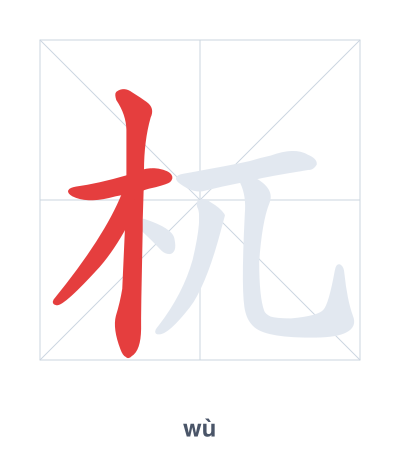
Open Hanzi Writer to see the animated stroke order and practice writing 杌 with real-time feedback.
The character 杌 (wù) is written with 7 strokes. Follow the standard Chinese stroke order: top to bottom, left to right, outside before inside. The radical 木 is one of its key components.
Practice the correct stroke order with the Hanzi Writer app to see animated stroke-by-stroke guidance with real-time feedback.
杌 means Stool; stump.
杌 combines the tree radical 木 (木) with 兀 (wù 'stump'), which itself depicts a flat-topped, bare tree trunk. Together they emphasize a cut tree stump, later extended to mean a low, blocky stool.
💡 Memory Tip: Picture a tree stump (木) with a flat top where a wobbly 兀-shaped man sits, using it as a stool.
他坐在小杌子上。
tā zuò zài xiǎo wù zi shàng
He is sitting on a small stool.
这是一个旧木杌。
zhè shì yí gè jiù mù wù
This is an old wooden stool.
房间里有一个矮杌。
fáng jiān lǐ yǒu yí gè ǎi wù
There is a low stool in the room.
Open Hanzi Writer to see the animated stroke order and practice writing 杌 with real-time feedback.
✨ Animated stroke order · Handwriting recognition · HSK-graded practice · Free to use
杌 is composed of the radical 木 (wood) on the left and 兀 (wù) on the right. The wood radical indicates that the character relates to wooden objects, while 兀 suggests a bare, cut-off shape, together forming the meaning of a stool or a tree stump.