芩 (qín) means "Scutellaria (skullcap plant)" in Chinese. It has 7 strokes with the radical 艹.
Rated 3.5/5 in difficulty (challenging).
Appears in 3+ common words including 黄芩 (huáng qín), 芩草 (qín cǎo), 芩子 (qín zi).
Due to its 7 strokes, Hanzi Writer's error detection shows 芩 requires focused practice — most learners need 10+ attempts for consistent accuracy.
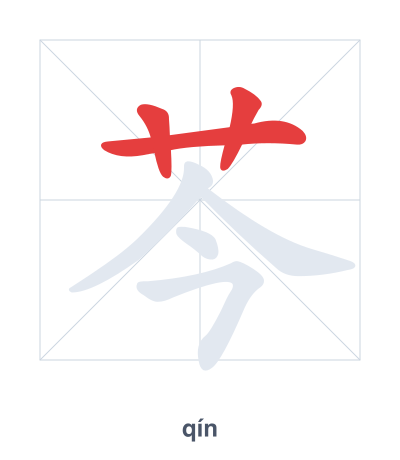
Open Hanzi Writer to see the animated stroke order and practice writing 芩 with real-time feedback.
The character 芩 (qín) is written with 7 strokes. Follow the standard Chinese stroke order: top to bottom, left to right, outside before inside. The radical 艹 is one of its key components.
Practice the correct stroke order with the Hanzi Writer app to see animated stroke-by-stroke guidance with real-time feedback.
芩 means Scutellaria (skullcap plant).
芩 is a phonetic-semantic compound: the grass radical (艹) indicates it is a plant, while the phonetic component 今 (jīn, 'now') hints at its pronunciation 'qín.' The character specifically refers to scutellaria, a medicinal herb known for its skullcap-like flower shape.
💡 Memory Tip: Picture a grass (艹) skullcap worn by a person saying '今' (now) — this is the herb that cures your headache right now.
医生开了黄芩。
yī shēng kāi le huáng qín
The doctor prescribed Baical skullcap root.
这里有很多芩草。
zhè lǐ yǒu hěn duō qín cǎo
There is a lot of skullcap grass here.
这种药含有芩子。
zhè zhǒng yào hán yǒu qín zi
This medicine contains skullcap seeds.
Open Hanzi Writer to see the animated stroke order and practice writing 芩 with real-time feedback.
✨ Animated stroke order · Handwriting recognition · HSK-graded practice · Free to use
芩 is a phono-semantic compound. The top radical 艹 (grass) indicates it is a plant, and the bottom part 今 (jīn) gives the pronunciation qín. Together, they form the name of the skullcap herb.