苌 (cháng) means "Chang (a surname or plant name)" in Chinese. It has 7 strokes with the radical 艹.
Rated 3.5/5 in difficulty (challenging).
Appears in 3+ common words including 姓苌 (xìng cháng), 苌弘 (cháng hóng), 苌楚 (cháng chǔ).
Due to its 7 strokes, Hanzi Writer's error detection shows 苌 requires focused practice — most learners need 10+ attempts for consistent accuracy.
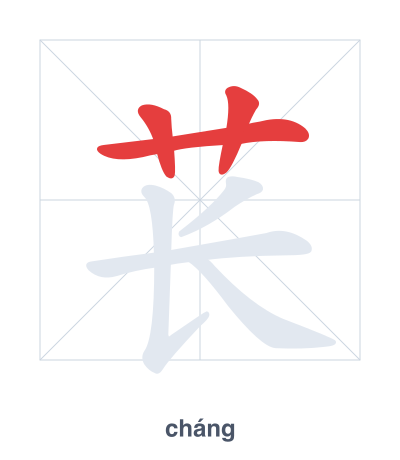
Open Hanzi Writer to see the animated stroke order and practice writing 苌 with real-time feedback.
The character 苌 (cháng) is written with 7 strokes. Follow the standard Chinese stroke order: top to bottom, left to right, outside before inside. The radical 艹 is one of its key components.
Practice the correct stroke order with the Hanzi Writer app to see animated stroke-by-stroke guidance with real-time feedback.
苌 means Chang (a surname or plant name).
苌 is a phono-semantic compound: the radical 艹 (grass) indicates a plant, and the phonetic component 长 (cháng, meaning 'long') gives the sound. It originally referred to a type of creeping or long-stemmed herb, and later became a Chinese surname.
💡 Memory Tip: Picture a long (长) blade of grass (艹) stretching out like a proud surname banner for the Chang family.
他姓苌,很少见。
tā xìng cháng hěn shǎo jiàn
His surname is Chang, which is very rare.
苌弘是古代的名人。
cháng hóng shì gǔ dài de míng rén
Chang Hong was a famous person in ancient times.
这种植物叫苌楚。
zhè zhòng zhí wù jiào cháng chǔ
This plant is called Chinese gooseberry.
Open Hanzi Writer to see the animated stroke order and practice writing 苌 with real-time feedback.
✨ Animated stroke order · Handwriting recognition · HSK-graded practice · Free to use
苌 is composed of the radical 艹 (grass radical) on top and a component 长 (cháng, meaning long) below. The grass radical indicates the character relates to plants, and the lower part provides the pronunciation cháng. This combination reflects its meaning as a type of plant or a surname.