毽 (jiàn) signifie « Volant (jeu) » en chinois. Il a 12 traits avec le radical 毛.
Noté 4.2/5 en difficulté (avancé).
Apparaît dans 3+ mots courants dont 毽子 (jiàn zi), 踢毽 (tī jiàn), 羽毽 (yǔ jiàn).
En raison de ses 12 traits, la détection d'erreurs de Hanzi Writer montre que 毽 nécessite une pratique ciblée — la plupart des apprenants ont besoin de plus de 10 tentatives pour une précision constante.
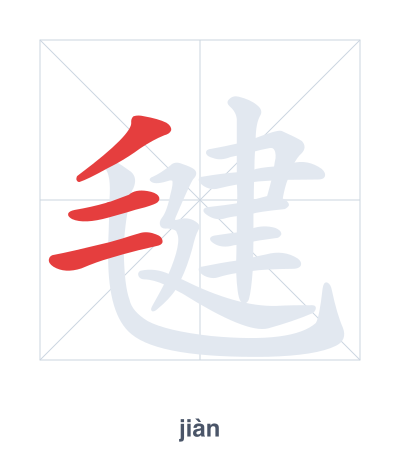
Ouvrez Hanzi Writer pour voir l'ordre des traits animé et pratiquer l'écriture de 毽 avec un retour en temps réel.
Le caractère 毽 (jiàn) s'écrit avec 12 traits. Suivez l'ordre des traits chinois standard : de haut en bas, de gauche à droite, de l'extérieur vers l'intérieur. Le radical 毛 est l'un de ses composants clés.
Pratiquez l'ordre des traits correct avec l'application Hanzi Writer pour voir un guidage animé trait par trait avec un retour en temps réel.
毽 signifie Volant (jeu).
| Caractère | 毽 |
| Pinyin | jiàn (jian) |
| Sens | Volant (jeu) |
| Traits | 12 |
| Radical | 毛 |
| Difficulté | 4.2/5 |
毽 combines the radical 毛 (máo, meaning 'hair' or 'feather') on the left with the phonetic component 建 (jiàn, meaning 'to build' or 'establish'). The radical suggests the feathery nature of the shuttlecock, while 建 provides the pronunciation. Historically, the shuttlecock was made with feathers attached to a base, and the character visually captures this concept of feathers as the defining feature.
💡 Astuce mnémotechnique : Imagine building a shuttlecock by sticking feathers into a coin: the 毛 on the left are the feathers, and the 建 on the right is the construction of the toy.
我们一起踢毽子吧。
wǒ men yì qǐ tī jiàn zi ba
Jouons au volant ensemble.
他踢毽踢得很好。
tā tī jiàn tī dé hěn hǎo
Il joue très bien au plumfoot (jianzi).
这个羽毽很漂亮。
zhè ge yǔ jiàn hěn piào liàng
Ce volant en plumes est très beau.
Ouvrez Hanzi Writer pour voir l'ordre des traits animé et pratiquer l'écriture de 毽 avec un retour en temps réel.
✨ Ordre des traits animé · Reconnaissance de l'écriture · Pratique HSK graduée · Gratuit
Le caractère 毽 est composé du radical 毛 (poil/plume) à gauche et du composant phonétique 建 (jiàn) à droite. Le radical 毛 indique que le mot est lié aux plumes ou aux poils, ce qui est essentiel pour un volant de jeu. Le composant 建 donne le son 'jiàn' et n'apporte pas de sens direct, mais il aide à la mémorisation du mot.