旎 (nǐ) signifie « Flottant / Charmant » en chinois. Il a 11 traits avec le radical 方.
Noté 4.2/5 en difficulté (avancé).
Apparaît dans 3+ mots courants dont 旖旎 (yǐ nǐ), 旎旎 (nǐ nǐ), 旎旖 (nǐ yǐ).
En raison de ses 11 traits, la détection d'erreurs de Hanzi Writer montre que 旎 nécessite une pratique ciblée — la plupart des apprenants ont besoin de plus de 10 tentatives pour une précision constante.
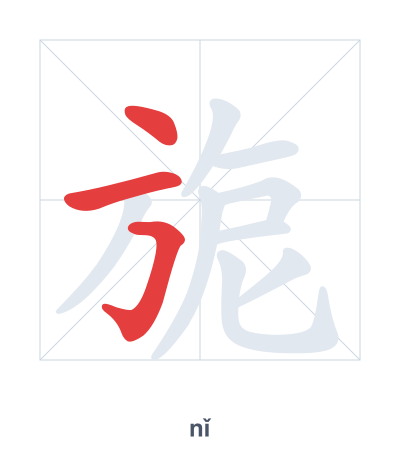
Ouvrez Hanzi Writer pour voir l'ordre des traits animé et pratiquer l'écriture de 旎 avec un retour en temps réel.
Le caractère 旎 (nǐ) s'écrit avec 11 traits. Suivez l'ordre des traits chinois standard : de haut en bas, de gauche à droite, de l'extérieur vers l'intérieur. Le radical 方 est l'un de ses composants clés.
Pratiquez l'ordre des traits correct avec l'application Hanzi Writer pour voir un guidage animé trait par trait avec un retour en temps réel.
旎 signifie Flottant / Charmant.
| Caractère | 旎 |
| Pinyin | nǐ (ni) |
| Sens | Flottant / Charmant |
| Traits | 11 |
| Radical | 方 |
| Difficulté | 4.2/5 |
旎 combines the radical 方 (a flag or banner) with 尼 (ní), which originally depicted a person sitting on a stool. The character suggests a flag or banner that moves gracefully, hence the meaning 'floating' or 'charming'. The phonetic component 尼 provides the sound, while the radical 方 indicates the semantic field of banners and movement.
💡 Astuce mnémotechnique : Imagine a flag (方) with a gentle, flowing ribbon (尼) that sways charmingly in the wind, creating a beautiful, floating motion.
这里的风光很旖旎。
zhè lǐ de fēng guāng hěn yǐ nǐ
Le paysage ici est charmant et gracieux.
旗帜随风旎旎。
qí zhì suí fēng nǐ nǐ
Le drapeau ondule au gré du vent.
景色旎旖迷人。
jǐng sè nǐ yǐ mí rén
Le paysage est charmant et enchanteur.
Ouvrez Hanzi Writer pour voir l'ordre des traits animé et pratiquer l'écriture de 旎 avec un retour en temps réel.
✨ Ordre des traits animé · Reconnaissance de l'écriture · Pratique HSK graduée · Gratuit
旎 est composé du radical 方 (drapeau) et du composant phonétique 尼 (ní). Le radical 方 indique que le mot est lié à un drapeau ou à un mouvement, tandis que 尼 donne le son. Ensemble, ils évoquent l'image d'un drapeau qui flotte gracieusement, d'où le sens de 'flottant' ou 'charmant'.